Showing posts with label ARC. Show all posts

Wednesday, September 30, 2020

Review: The Puppeteer by Kathryn Ann Kingsley

 The Puppeteer is the second book in Kathryn Ann Kingsley's Harrow Faire series centering around the truly delightful Cora Glass. She was an every day girl who once dreamed of being a photographer before Ehlers Danlos Syndrome's chronic pain took her dreams from her and landed her in a boring 9 to 5. Now she's caught up in what she likes to call a Man-Eating Murder Circus, more or less compliments of Simon.  Oh, Simon, the Puppeteer. If you have been following Kingsley's work, you aren't going to be surprised by what I'm about to say.


I love that evil madman, and I love him even more every time Cora puts him in his place.
Romantic lead yes, hero, no. Evil, yes. Loveable, yes. Good guy? No. Sexy as all get out? Yes. Desirable? Yes. Sane? No. Do not forget this. Do. Not. Forget. This.

Ooh, our feisty heroine has so much delightful snark and wit coupled with a tenacity that just won't stop. She's smart and always ready to fight. I big puffy heart her, and it has nothing to do with all the ways she can bend, whether it's on stage or in her bedroom. Get your mind out of the gutter, none of that... yet. So far as I'm saying. You have to read it to find out.

And you have to read it.

This series needs to be read not just for the hotness, and there's hotness. Read it for the glorious characterization. Read it for the fact that you're not normal and neither are the characters. Read it for the heart touching way that Cora sits on the grass and carries on a conversation with a mute character. Read it for genuine human connection in an inhuman world. Read it because we are all living in isolated little pocket worlds these days, and that makes it all the more painful to see Cora's world being ripped from hers.

The menacing and eerie carnivorous circus has all the best setting vibes for this self discovery and otherworldly super dark romance. Do yourself a favor and give yourself permission to indulge and enjoy it. Just remember, I warned you. He's a not a good guy.

Ooh, I just can't wait for the next one! There's a series shaped hole on my bookshelf.

Sunday, September 6, 2020

Review: The Contortionist by Kathryn Ann Kingsley


Remember the time you were driving on your daily commute and you saw it: that one thing that was just entirely not the way you remembered it being, and you were dang sure that you didn't see the changes taking place? That Mandela Effect feeling of "something is very wrong in the universe?"
Well, welcome to Cora's world when one day the long abandoned and decaying Harrow Faire is suddenly no longer abandoned or decaying, but open again and hungry for guests.

Kathryn Ann Kingsley creates a glorious blend of creepy circus and carny freak-show with modern wit and skepticism.  If I had to toss a few stories in a blender to lead you to The Contortionist, I'd start with Something Wicked This Way Comes, add a little The Night Circus, and follow up with some good old fashioned Black Butler. 

I'd just go with an emphatic "do read," but it's more than that. Read it for the way Kingsley writes differently abled characters. Read it for the spider's web of atmosphere. Read it for the way you find yourself wanting the heroine to walk into the maw of the beast. Read it for the villains: the gloriously sexy villains. Read it for the existential questions it begs you to ask yourself, like "what would you give," and perhaps a little more on the nose, "what's your favorite color?"

It's book one. I want to devour the whole series like a glutton. I want to bathe in the atmosphere, and glut myself on surreal nightmarescape. I want to drink this story in and roll it around on my tongue and taste all the sweetness with the faint bitter edges. Beautiful stuff.

Fans of Kingsley's work might be surprised that it isn't particularly graphic. Regardless, it's breathtaking. 

I'm looking forward to having this whole pretty set on my library shelf soon.

Tuesday, August 4, 2020

Review: Burning Hope by Kathryn Ann Kingsley

Kathryn Ann Kingsley's second book in the The Cardinal Winds Series, Burning Hope, just dropped in paperback and I had the chance to read a review ARC.  You guys. 
You. Guys.
It's got a little bit of everything. Magic. Complicated ruinous and abusive back stories. Origin story mysteries. Social justice issues. Political intrigue. Steamy goodness. Greek pantheon. A zoo. Love. Everything. 
When I first started, I wasn't sure I was going to really be able to get into it the way I got into the first in the series, Steel Rose, because the male lead Burning Hope, Nero, was an absolute unmitigated nightmare of a jerk in Steel Rose, right up until the very last heart stealing page of the book where he goes and makes you grow a tiny little soft spot for him.That said, it's tiny, and so I expected Burning Hope to be a big uphill climb for me. 

Surprisingly, it wasn't. He's a violent, hedonistic madman perfectly described at one point in Burning Hope as "He was playful. Like a murdering puppy. But still a puppy, all the same." Suddenly, his overbearing ways became oddly endearing and awkwardly charming. And the female lead in this? Hope? 10/10 do adore. She's smart, outspoken, and remarkably honest. I also appreciate a differently-abled character who isn't helpless. That's one thing that this series keeps coming back to, bodies that might not be perfect, people whose pasts have left them permanently psychologically damaged, and they're the focus of heart pounding lusty love stories mired in politics that are somehow still socially relevant to the here and now, despite being set in an alternate kind of science fantasy world of dirigibles and ray guns. The magic end of the story is pretty cool too. There are a very few people who can wield any type of it at all, the Cardinals of the four winds, and Nero, the South Wind, has powers of some pretty intense inhibition stripping hypnotism and fire. 

I admit, I want to go back and read a few scenes again, when I'm not being interrupted left and right like this lady. 

Because frankly, the super descriptive NSFW scenes were hot, and not just because Nero has control of elemental fire, and they deserve to not be read a few lines at a time. Of course, I didn't want to put the book down, so reading with interruptions it was.

Burning Hope is available now in paperback and will be available in September for Kindle. Excellent read. It can stand alone, so you don't have to read Steel Rose first if you want to dive straight in to the story, but you'll be missing out on one heck of a great story if you do. I just can't wait for the next two in the series, and am secretly pulling for some side stories (Otto and Kema need their HEAs too.)

Thursday, January 1, 2015

The Magician's Lie

Spellbinding. The Magician's Lie weaves an interconnected tale as fragile and as convincing as any of the great illusions of the Edwardian era. Steeped in tight historical detail, grandiose architecture, and the art of prestidigitation, Greer Macallister masterfully enchants her audience with the tale of Arden, an illusionist whose freedom and life will hinge on a private performance for a lawman in a rural Iowa sheriff's office during the tired hours of the night.

A story as abusive as it is beautiful, The Magician's Lie is filled with grit and opulence, pain, sorrow, and the countless heartaches that hinge on the word "if." Written with a pace that reminded me of The Night Circus, The Magician's Lie rivals The Prestige in terms of human drama played out on the stage and immaculate storytelling.


I received an e-ARC of this book through NetGalley.


Monday, September 22, 2014

A Murder of Magpies

One for sorrow, 
two for joy.
A destructive girl,
a damaged boy.

Sarah Bromley knows how to create an atmosphere, draw a reader in, and ease them into her grip until they're so firmly in it that they can't break free, even to get some more tea. Her magic is in the details.

A Murder of Magpies is the story of Vayda, a girl whose family is running from a past so horrifying they dare not even use their names, her brother Jonah, who struggles against the power inside him, his ties to his family, and a yearning to fit in, and Ward, a boy whose utterly dysfunctional home life has left him broken on the inside in more ways than one. I found it ironic that throughout A Murder of Magpies, Vayda, who is so much an outsider to the tiny town of Black Orchard, Wisconsin that she'd been there three years without making a real friend, repeatedly pushed Ward away calling him gadjo- outsider.

The use of body language, in and of itself, made this a worthwhile read. Bromley pays keen attention to detail in constructing her story, which is filled with subtle foreshadowing, wonderful relevant glimpses of backstory, and although it spans several states, the cast of characters and locations are kept few enough to infuse them with a wealth of character and detail.

A strength of A Murder of Magpies lies in the way it deals with uncomfortable territory. Two of the strongest themes in the book which will unsettle readers and give them food for thought and conversation are bullying and consent, which is why I recommend it for book clubs, because there is a wealth of conversation material between the covers. A Murder of Magpies explores the boundaries of will and ethics, probing each character's moral fiber, as well as the reader's. Of course, the dialog the reader has with herself is always more telling than the one she would have with a group of people, but I think it would be hard to walk away from this book without having examined their own view of right and wrong a little more closely.

Regarding consent, A Murder of Magpies deals with consent in a wide spectrum of manifestations, from question of sexual consent to other venues in which one's will can be subverted. Bromley treads boldly, but respectfully into uncomfortable territory, and I respect the choice. Moreover, her portrayal of bullying and the violent undertow of an environment that nurtures bullying struck me as important to the culture in which her characters and readers coexist.

I like that the characters she's created are bookish, even if they're not great students or terribly great with authority. I like that because her readers are probably bookish, because heck, they're reading, right? I like that Vayda and Ward could nearly be any of the readers if their lives were just 7% more peculiar. Vayda is easy to relate to without coming off as a hollow character (ahem, Bella Swan), and Ward too feels like he's just a step removed from so many people while remaining an individual. Even the antagonists rise above archetypes, and it makes for a good read.

I was very fortunate to be able to read an ARC of  A Murder of Magpies. I'd gotten my hands on the three chapter teaser in the spring and was desperate to get my hands on the full manuscript. I plan to buy a signed copy for my bookshelf in the near future, like, you know, when it's available to purchase.


Monday, September 1, 2014

When Mystical Creatures Attack

Witty.
Painfully funny.
Surprising on nearly every page, and so downright eccentric I felt like perhaps Kathleen Founds had somehow been possessed by the same perverse and brilliant muse that moved Douglas Adams and inspires Jasper FForde.
When Mystical Creatures Attacks blends whimsy and reality, raw emotion and unconventional storytelling to create something downright fabulous.
I usually do not go in for short stories, but these aren't short stories, they're glimpses through surreal windows that look out on a landscape that resembles, all too keenly, looking in.

The truth is, you'll pick it up because the cover is fabulous. That's what caught me. But you'll stick with it because it's excellent. Then, halfway through the first section, the essays from Ms. Freedman's class, you'll be flipping back to make sure you picked up a work of fiction, because each voice is so distinct, surely they couldn't all have been penned by the same woman. But they were. And then you'll be caught, just as surely as the unicorn on the cover.


I had the pleasure of reading an e-ARC of this title via Netgalley.

Thursday, August 14, 2014

Call Me Grim

Elizabeth Holloway hits the ground running and does nothing but pick up pace throughout Call Me Grim, the edgy YA novel that brings new meaning to the phrase "damned if you do, damned if you don't." In Call Me Grim though, Libbi isn't the only one who has to worry about damnation, she's got the soul of her best friend to worry about.

Full confession, I thought the premise had about a 75% chance of being pure cheese. It wasn't. This was like winning the book review lottery. The characters are fully formed, the dialog engaging, motives genuine, plot twists interesting and even surprising. I was impressed. Moreover, I can see this growing into an interesting series that is about something a heck of a lot larger than boy meets girl or girl saves friend, and I like that.

The premise: death saves a girl, but there's a catch, a huge catch, and it just might be a fate worse than death, caught me off guard. I was ready for "girl dies and gets offered a job to atone," or "girl inherits family job of collecting souls," but "girl trades in a chance at heaven to keep her friend from going to hell, all because the current reaper has personal reasons for wanting out of the whole reaper gig," well, where do I send the "thank you for your originality card?"

Pacing aside, what I liked the most about Call Me Grim, was that it contains a lot of food for thought, especially about what it means to be a friend, and the moral weight of our ties to one another. I'm not sure if that's what Holloway was aiming for, but that's what I came away with... well, that, and a heck of a rollercoaster ride of a story.


I received an ARC to review from the publisher.


Wednesday, August 13, 2014

Coral & Bone


I had the opportunity to read Coral & Bone for an upcoming Blog Tour through Xpresso Blog Tours. You can check that review out on We Do Write in September.  Of course, I'm not big on waiting, so, I figured I'd dive on in now.

Can I just say, holy gorgeous cover, Batman?
Coral & Bone by Tiffany Daune was a pretty good book. I enjoyed the story and found myself laying awake later than I'd intended to finish just one more chapter, and then thinking about the characters long after I'd set it down.  It was not a one sitting book for me, partially because of it's length and the amount of world building, and partially because every few chapters I felt the need to pull on my swimming suit and find a pool.  My family jokes that I'm a bit of a mermaid myself, of course, in Coral & Bone, that's not a good thing.

In Coral & Bone, Halen, a nearly 15 year old girl, finds herself having returned to the dreary small beach town where her family lived when her father drowned in open water, which she recalls in images of silvery tails. Of course, Halen also finds fire tingling beneath her touch and goes to school with earplugs in to block the overwhelming sensory input of the world around her. Of course, the run-in with mermaids some six years earlier was nothing compared to the drama ignited when she reencounters them after a mysterious young man shows up on her front stoop.

In the first chapter, Halen passes out during a math test because she took out her ear plugs, and this moment sets the stage for the balancing act between her strengths and weaknesses throughout Coral & Bone. Again and again, her abilities push her over the edge, and again and again, she finds herself diminished by them. In some ways I thought the wording was ableist. Halen frequently questions her sanity toward the beginning, and yes, I imagine anyone being pulled from the mundane world into a realm with different rules and different beings might question their sanity, or at least struggle with disbelief. However, the frequency of "crazy" and "insane" statements detracted from the meaning of the words, because they felt like they were being used too liberally.  I know it's a small point, but it's one that wears on me, as a reader.

Similarly, I really dislike the magic k. I know, it's a personal preference thing, but I wish my e-reader had a way to go through and replace all the "magick" with "magic," because it throws me out of any text that isn't a historical text discussing the trend in neo-mystycism and pagan movements toward adding a k in order to differentiate between prestidigitation and illusion and their own brand of magic. It's like fingernails on the chalkboard of my soul.

Speaking of which, so is a cast of Earth dwellers living in contemporary times comprised entirely with bizarre names. Enter Halen, Daspar, Tage... you get the idea. However, it worked in this case. I liked them and their unique names fit the characters and their backstories in ways that Helen, David, and Teague wouldn't have. So props on that.

I think what I liked the most about Coral & Bone was that it surprised me, even the predictable parts surprised me. Sure, we all see them coming, but they unfold in subtly different ways, and it feels good to read the well foreshadowed event with the tiny little twist. I like that Halen was set up to be a bit of a swooning Bella, easily overwhelmed, easily captured, easily led along, despite obvious personal power, but then BAM- she makes choices without equivocation and sets her own destiny. I like that.

I also really enjoyed the world building Tiffany Daune put in. There's a great amount of detail, her magic system has rules and she follows them, and there is room to expand on it. Coral & Bone also exists outside the realm of quest or romance in that there is a political/social justice/ equality arc as well. While yes, there is the "destroy the bad guy, save the realms" element to the story, it really only serves to illuminate the greater problem, that Elosians truly believe that genocide is alright as long as it makes them feel safer. The social justice issues dominate the landscape of the story, and make for an interesting tale.


Saturday, July 12, 2014

Guilt-free Baking

I had the pleasure of borrowing a review ARC of Guilt-free Baking through Netgalley.

 Usually, low fat desserts involve a lot of sugar, and low-calorie baking is just a nightmare of chemical soup. But whole grains and solid ingredients carefully balanced to create the perfect baked good? Now that's a concept I can get behind. Of course, they really got me at Lavender Cupcakes. I have a soft spot for cooking with lavender (any edible flower, really, but lavender in specific- it's what defines the cola flavor profile), and when the ingredient list is as smooth as self rising flour, baking powder, baking soda, sea salt, dried lavender, sugar, plain yogurt, vanilla bean paste, milk, and sunflower oil... well, you have an eager audience.

I admit my skepticism is only outweighed by my curiosity when it comes to the chocolate cupcakes with avocado frosting. I may yet have to attempt this recipe. The directions, as with all the directions in this book, are straightforward, and I don't feel they exceed my culinary talents. A great boon to the decision making process, when staring down any of these recipes, is the quick nutrition guideline for each recipe, delineating the calories and fat along with approximate prep time and number of servings. Of course, that only holds if you follow the recipes as written instead of venturing off on your own, using them more as a guildebook than anything else.

All in all, a good book to expand your less guilty indulgence repertoire. 


Thursday, July 10, 2014

Skylight


When Curled into a good book, it takes a truly witty or moving turn of phrase to pull me away from the next morsel in order to take notes, or to mark a passage.  Yet, something in Carol Muske-Dukes word choice, her deft execution of the trickster form, the seductive way she turns a poem on the reader and leaves them as exposed as the subject matter, left me marking passages again and again, notating over and over, "yes! this is exactly how it feels," or "Mrs. L. needs to read this." Twenty-two times she caught me, brought me up short, and sent me scrambling for a way to remember her words and the way they made me feel in that moment.

Her word choice in The Painter's Daughter,  "Coaxing the murder that no one saw from the stubborn evidence of light." It's visceral, full bodied, and yet somehow alienating. When she writes about the opium trip of a man who seems to has lost his lover, perhaps his wife in a car accident that was his fault, but that he can't escape the pain and guilt of, the poem begins so inconspicuously, but ends so painfully and hauntingly, it's like a scab you can't help but pick.

Her writing puts me in mind of Margaret Atwood, and will stay with me. Her work is uncomfortable, explores, child loss, abandonment, violence, abuse, gender identity, and ivory tower feminism. It certainly won't be everyone's cup of tea, but for those moved but such tea, it is strong tea.

Skylight is published by Open Road Integrated Media and is available on Amazon.


I  recieved a free review copy through Netgalley.


Saturday, June 14, 2014

We're the Center of the Universe: Science's Biggest Mistakes About Astronomy and Physics

One of the great things about science is that it is a method by which we get to seek answers to the really big questions. Of course, science gets it wrong, a lot, along the way to getting it right. When I was young, a science teacher once introduced himself and then immediately apologized for lying. He said he didn't mean to, but that when you taught science, it was pretty much guaranteed that something the scientific community supported would eventually be proved wrong, but that was okay. Science gets new data, reforms it's ideas, adapts and moves on to solve bigger questions. That's why science is cool.

In that spirit, Christine Zuchora-Walske's book, We're the Center of the Universe: Science's Biggest Mistakes About Astronomy and Physics really makes me smile. It sums up not only the ideas of yore, but why they made sense to the people who came up with them. I like it because it makes me feel like the kid who reads this is going to say "so even if I get the science wrong, there's something to gain from the process of seeking the solutions." I like that.

I like this book because it approaches the history of ideas and illustrates that what seems like the common heiliocentric view of a vast universe we inhabit, in a relatively unpopulated solar system is a very recent concept. These are important ideas and they're presented in a fun and accessible voice. 

This was a fun read and I can think of about ten of my nieces and nephews who  need to read it.


I received a free eARC of this title for review purposes. I have not been compensated in any other way for my review, which was not swayed in any way by the free nature of said ARC.

Wednesday, June 11, 2014

Handbag Workshop: Design and Sew the Perfect Bag


If you've ever struggled to make your own bag and thrown your hands up in dismay, this is the book you want on your studio's shelf. If you've ever wondered how to "press" your seams when working with leather, you want this book on your studio's shelf. If you've ever gotten tongue tied trying to describe the bag you wish you had, fumbling for the word to describe it, this is the book you need. Complete with a working lexicon of bags, Anna Mazur's Handbag Workshop will help you understand the difference between a messenger, a satchel and the more ladylike Kelly, and why a Minaudiere isn't the same as just any old clutch.

Complete with instructions, pictures, and really key warnings, like a friendly reminder that leather isn't going to heal if you pin it, Handbag Workshop: Design and Sew the Perfect Bag walks you through a plethora of projects, including the hard things, like how to attach diverse bits of hardware and trims for the one of a kind professional and artisan look.

Now, not every project in the book was my cup of tea, but the techniques from every project can be applied to my own designs, and I'm all about that. Ultimately, a good workshop book needs to be adaptable and full of useful tidbits that can be applied to other projects rather than techniques that are so project specific that one will literally never use them for anything else, and Anna  M. Mazur's book really hits it out of the park in terms of knowledge that adds to the reader's functional technique repertoire. Because the instructions are clear and the pictures relieve any remaining questions, this is an easy book to use. The author gets bonus points for breaking down her bag designs into different sections for varying difficulty levels. I think I see a Tiffany Inspired Reversible Tote in my future- and a Cross-Body Sling Bag with Tablet Pocket. I'm a cross-body purse wearer, at the end of the day. It may not be the most elegant, but it is the most functional.

Happy Sewing!


I received a free eARC of this title for review purposes. I have not been compensated in any other way for my review, which was not swayed in any way by the free nature of said ARC.

Tuesday, June 10, 2014

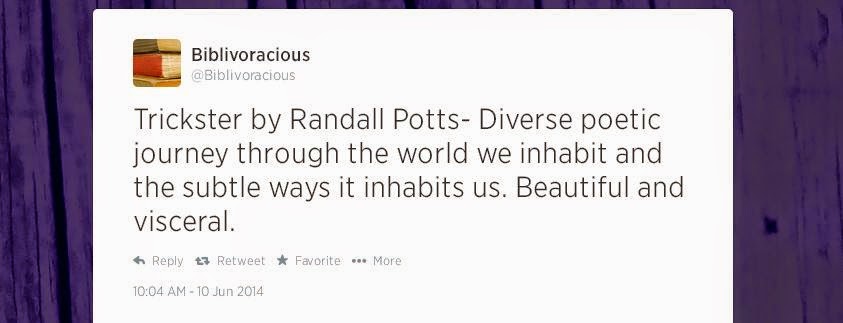
Trickster

 Biblivoracious

"I can't read this passage in a language I was never taught."
-Trailhead

Poetry is a curious beast. As Potts wrote in Fable, the piece illustrated on the coverhis collection "began innocently enough." In the classic sense of a trickster poem, the first poem invites one into a simple setting, then twists the scenario masterfully. However, my favorite poems throughout this collection were the ones that encapsulated complex moments and ideas.

A moving and diverse collection filled with earthy and naturalist reflections as well as visceral reminders of humanity's relationship with the animals with whom we coexist and upon which we depend for our food. At times, the grit and brutality with which Potts reduces breathing life to meat and bone unsettled me, I far prefer unsettling poetry that made me feel than simple rhymes that failed to evoke an emotional response. Through his exploration of the natural world and man's interaction therewith, Potts seldom fails to deliver on the promise of emotional awakening.

Trickster, from University of Iowa Press, is a diverse collection, and of course every poem will not appeal to every reader, and likely each reader will find some poems off putting while others will knit themselves to the reader's heart. Trickster is filled with images that will haunt and short turns of phrase that will echo in the reader's mind for years to come. This is a fine collection to enjoy in a light breeze under the evening sky, or perhaps in one's favorite reading chair in a living room that doesn't fill with smoke- though I suggest reading it on paper, because in a literary world seemingly devoid of modern technology,  there is something of a cognitive dissonance in reading it on one's e-reader.

I received a free eARC of this title for review purposes. I have not been compensated in any other way for my review, which was not swayed in any way by the free nature of said ARC.

Friday, June 6, 2014

Hand Stitched Home: Projects to Sew with Pendleton® & Other Wools

Filled with spirit bolstering photographs of great projects to make out of wool blankets that may be sitting underloved in your cedar chest, Hand Stitched Home: Projects to Sew with Pendleton® & Other Wools by Susan Beal offers a plethora of inspiration that doesn't drop off just because you don't own any Pendeltons. I, for one don't, but that doesn't stop me from eying all of the lovely underused wool that has accumulated in my house for the thrilling (maybe I need to get out more) pennant project she outlined. I admit, I have a thing for pennants.
I enjoyed the diversity of projects Susan Beal's book offered, and for me, it was the right book at the right time. I've been on a bit of a purging kick lately. Nobody wants to be a hoarder, but being wasteful is even worse in my head, so a whole book devoted to the repurposing of iconic textiles struck a chord with me. In addition to offering a wide variety of ideas, Hand Stitched Home offered careful and easy to comprehend instructions, and scaleable pattern pieces.
For anyone familiar with using patterns found in magazines or other books of this kind, it will be easy to fall right in with the directions and quickly find yourself on the road to turning vintage flea market finds and linen closet inhabitants into functional pieces in which you take great pride.


I received a free eARC of this title for review purposes. I have not been compensated in any other way for my review, which was not swayed in any way by the free nature of said ARC.

Wednesday, June 4, 2014

Fine Cooking Cakes & Cupcakes: 100 Best-Ever Recipes

Fine Cooking Cakes & Cupcakes: 100 Best Ever Recipes
I don't know if I am enjoying the pictures, the possibilities, or the few desserts I've ventured into attempting so far. Full disclosure here- my aunt is the genius in the kitchen (read: five-star pastry chef)- I'm just a woman who really likes some delightful cakes and cupcakes. I mean, what is better than a cake? A cupcake. What's better than a cupcake? Just about nothing.
I like the witty upside-down upside down cake photos. I love that this cookbook breaks down the recipes into easy to understand and follow directions, and that the good folks at Fine Cooking Magazine also included the nutritional information on every recipe. It stopped me from trying a recipe or two that I wanted to, but it also gave me the conviction that a few I might have shied away from were absolutely a-okay to go ahead and give a whirl.
Fine Cooking Cakes & Cupcakes: 100 Best Ever Recipes has a lot of great points, one of which is that it doesn't focus on just one type of cake, or just on traditional flavors. Instead of a plethora of chocolate and vanilla and a smattering of fruits, there are ginger and cinnamon, and all sorts of delightful goodies, like caramel.
There are recipes for breakfast cakes as well as the decadent indulgences one imagines when looking a cake and cupcake book.
I'm very glad to have this in my arsenal for entertaining and for when I have to pull something fabulous together for a potluck.
Full points for optical eye candy, and full points for a great set of recipes.

I received a free eARC of this title for review purposes. I have not been compensated in any other way for my review, which was not swayed in any way by the free nature of said ARC.


Thursday, February 13, 2014

Banish Clutter Forever: How the Toothbrush Principle Will Change Your Life


Banish Clutter Forever: How the Toothbrush Principle Will Change Your LifeBanish Clutter Forever: How the Toothbrush Principle Will Change Your Life by Sheila Chandra
My rating: 3 of 5 stars

Embracing the simple yet fundamental truth, that organized people who live in clean spaces are actually just as lazy as the rest of us, Sheila Chandra's method to get your house to work for you involves work, but once you apply it, once you practice it, is actually something a person can maintain.
Although I don't love the way Chandra writes and her analogies reflect some truly cringeworthy biases and misinformation, like the nearly put-it-down-and-walk-away worthy "Does being overwhelmed by your stuff and being trapped by it feel like being overweight or in debt? That's because in a way it is. Being overweight or in debt is usually caused by the wish to defer the decision and effort it takes to take control of your health or finances. It is the 'Not now, I will be sensible/sort that out later...' philosophy." I don't approve with conflating obesity and laziness, or obesity and difficulty making decisions, or obesity and any other one thing. Of course, this is a book about taking control of one's possessions and surroundings, not one's body and health, so let's move on.
I liked that while Chandra shares her personal experience with clutter and the special sort of despair it can breed, the whole book doesn't live there. It isn't a constant reminder of how horrid it was to grow up with a mother with a mental disorder as organization books can turn into. Chandra deals with the emotional clutter when it's constructive, and moves on. Better still, rather than wasting the reader's time by saying "read my whole method, then try implementing it," she suggests trying chapter two before reading any farther. If it works for the reader, great- read on. If not, put the book down and find something else.
Of course, like a good girl, I read chapter two and (nearly) followed her directions. Why just nearly? Well... I hate following directions. Actually, I felt overwhelmed by the task of finding a notebook to write anything down and figured that it was a small enough bathroom that if it otherwise worked, I'd invest in (finding) a notebook for moving forward with the rest of the house.
As a FlyLady washout, we'll see. Right now, I feel like this can work, and if nothing else, the methods and techniques I'm putting into practice here are well worth knowing, even if I don't use them religiously.
Spring cleaning, here I come.

Wednesday, January 29, 2014

The Plant Lover's Guide to Salvias


Redolent with decadent color and brimming with enthusiasm for salvias, The Plant Lover's Guide to Salvias is sure to kindle your passion for this beautiful plant, and to ignite your creativity in garden planning. Drawing from his extensive knowledge of the different varieties of salvias, John Wittlesey has pulled together easy to understand lists to help any gardener find the salvia that best suits her need, whether she prefers a salvia with dramatic foliage, such as Salvia officialis Icterina, or one best suited to cutting- like Salvia sclarea. Looking for something to fill in and add texture to a rock garden, this book will steer you in the right way. Need a fragrant but sturdy groundcover? Whittlesey has something for you as well. The Plant Lover's Guide to Salvias even has something for those who are tired of purple.

Detailed plant identification information and an explanation of their place in the world of pollination makes for an informative book, rather than just a pretty one. Of course, the most useful part is probably the section picturing each cultivar of salvia and explaining its type, habit, size, hardiness, origin, and landscape use. Of course, if you live in the cold northern expanses, you might have a moment's jealousy when you see the gorgeous cultivars that thrive in zone 10b. That said, I think I am going to try to incorporate some Salvia caespitosa into my garden this year. Not only is it beautiful, but it's suited to zone 5, and I have been planning a rock garden for a while now.

All in all, it is a beautiful, easy to follow, instructive book that incidentally has a lot of coffee-table value as well.


For more of my gardening book reviews, check out Paisley & Pretties.

Monday, January 27, 2014

Change the World Before Bedtime

Change the World Before Bedtime
Most kids want to be heroes, and this book gives them practical ways to achieve that goal. Written in sing-song rhyme, Change the World Before Bedtime, a collaboration between Mark Kimball Moulton, Josh Chalmers, and Karen Good, inspires kids, no matter how little, to do the things they can to improve the world around them. A positive and encouraging story, Change the World Before Bedtime promotes stewardship, manners, and civic engagement. I liked nearly everything about it except the font, which could have been a touch larger for reading upside down to a group of kids, and could have had a touch more whimsy to better match the marvelous and endearing illustrations- but don't let that stop you from reading it. You'll be glad you did, and so will your kids.


Sunday, January 26, 2014

The Little Moose Who Could Not Sleep- A Maynard Moose Tale, by Willy Chaflin & James Stimson


The Little Moose Who Could Not Sleep - A Maynard Moose Tale

When your young ones are full of sleepy, but bedtime rolls around and instead of sleeping, they think big thinks that keep them awake, this is precisely the bedtime tale you need. Full of whimsical and colorful pictures and a storytelling vernacular that pulls the reader into the tale, The Little Moose Who Could Not Sleep is both endearing and engaging. I enjoyed the folksy language and the imaginative characterization of the Little Moose, but most dearly, I love the bit about Mother Moose making the universe out of thin air.
The Little Moose Who Could Not Sleep packs a lot to think about into forty pages.

Saturday, January 25, 2014

RATGIRL: Song of the Viper


Krause's dystopian tale delves into the heart of what people will do to survive, and how far from the life they want they are willing to go in order to provide for the people they love. All in all, I liked it. I liked
the way she created characters who were despicable in the same ways that the despicable people we've all met would be if put in power or under strain, and I liked that she took the types of good people who are everywhere, and had them reacting realistically within the tight prison of poverty, fear, and darkness resulting from the corruption of the local government as well as the threat of the sun. These aren't heroes who can't be touched by minor irritations like chapped lips- they're real, they're hungry, and they're going to survive.

You can read my full review on We Do Write.