Showing posts with label gardening. Show all posts

Wednesday, December 10, 2014

Grow a Little Fruit Tree

Beautifully illustrated, and designed with remarkable attention to aesthetics, this is a  delightful combination of information and art. Moreover, the concept behind the book is so simple and seductive: grow a little fruit tree. Grow fruit. Grow it small. Keep it manageable.  That's the sort of thing that makes a reader think- yes, I can do that.

Dealing with the necessary steps involved in growing a small fruit tree, as well as the reasons why one would want to- after all, over producing isn't really going to do you any good, is it? Small trees take up less space, and are easier to both care for and harvest. Filled with charts, diagrams, and decades of experience and anecdotes that will help any gardener remember that an 8' tree really does in deed get larger than one can reach on one's own, if left to it's own devices, Grow a Little Fruit Tree is the perfect guide to growing fruit at home.

I plan to add this to my permanent collection of books on espalier techniques, as it has long been my intent to turn my unused patch of yard the other side of the garage into a small fruit tree orchard. Grow a Little Fruit Tree makes me feel like I have the information I need to do it successfully. The detailed pruning instructions and pictures alone make this a wonderful addition to any gardening library, but like I said, I'm partial to a book that discusses espalier technique.

Beyond being informative, Ann Ralph's writing technique is both accessible and entertaining. Her tone is conversational and a real love of growing fruit trees comes across in the ink. Of course, it all boils down to whether or not I learned something. As I said, I've been looking at growing little fruit trees for quite a while, so it's a subject I've been studying for a while now, and yes. I learned pollination techniques I hadn't yet found in other books on fruit trees, and more about pruning than I knew when I opened it up.  It was well worth the read.

I was overjoyed to have the opportunity to review an e-ARC of this title through NetGalley.

Tuesday, June 3, 2014

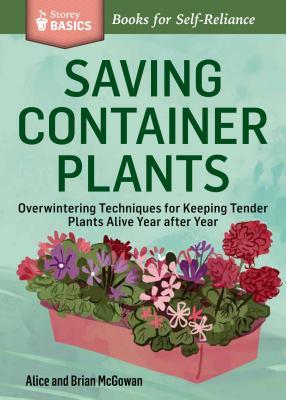
Saving Container Plants: Overwintering Techniques for Keeping Tender Plants Alive Year after Year


 In Alice and Brian McGowan's new book, Saving Container Plants, they give their readers a solid walk through to saving a wide variety of plants that it's fairly likely their readers were rebuying year after year in order to enjoy them year after year. Of course, that's wasteful, and so the McGowans have stepped up to the plate and offered some detailed advise on how to keep those tender plants alive without the benefit of the climates to which the plants are accustomed.  As a gardener at the northern edge of zone 5, I appreciate their advice tremendously.
In Saving Container Plants, I got a quick reminder on the actual difference between a perennial and an annual, with an emphasis on the fact that just because I treat it like an annual in zone 5, that doesn't mean it is really an annual, and then a walk through on how to choose which plants are likely to benefit most from overwintering via their recommended methods, always keeping in mind my own preferred overwintering patterns. No, no I'm not willing to turn my thermostat down below 65 degrees, but yes, yes my basement just might be about that temperature. Sunny windowsill in the basement, I've got... one.

A great thing about Saving Container Plants is that Alice and Brian McGowan don't assume the reader knows a thing about keeping a plant alive indoor or out of doors, and they don't assume the reader has remembered that they want to protect their floors or furniture from their containers, so they even remind the reader of the little things like saucers under the pots. They also point out that some plants, particularly  tropical ones, are probably going to like to be treated like houseplants and enjoy sitting in a sunny window or even benefit from artificial light, at room temperature, but that doesn't apply to all of the plants one might want to save. Drawing a distinction between plants based on origin, the authors outline different environments better suited to plants which require various degrees of dormancy during the winter months. Yes, Virginia, that may even mean putting some plants in a dark cold closet. Really. I know I had heard of overwintering some bulbs in boxes or bags before, but hadn't really read up on it before this, but now it makes a lot more sense.

In addition to outlining basics like how to meet the needs of tender perennials based on their origins, Saving Container Plants delves into techniques for taking cuttings to save a plant for the next season while saving space, as well as options for transplanting  and downsizing larger plants for the same reason.

The plant by plant breakdown of overwintering, propagation, and common pest problems is probably my favorite portion of the book, because if you know what you have, it can help a gardener quickly determine what to do with it, or if overwintering it is something feasible for  his/her space, energy, and commitment level. I do admit a twinge of guilt on reading the Aloe section as I didn't expect our sudden hard freeze that came so early last fall, and all my aloe died. I'll get it right this year. Promise.

Having Saving Container Plants on hand has also given me the courage to try try again to overwinter fuchsia. It is one of my favorite not-quite-hardy-enough-to-actually-grow-here plants, and my kids enjoy the berries all summer, so this year, we'll see if we can make a go of keeping it alive year round. I think if I couple a little tenacity with the advice in this book, I can do it.

All in all, I liked Saving Container Plants: Overwintering Techniques for Keeping Tender Plants Alive Year after Year. It contains a wealth of information to help keep one's plants healthy, and the words of wisdom necessary to keep it from overtaking one's entire home. I admit a moment's disappointment that my eye-candy seeking wasn't particularly rewarded this time. I freely admit that one of the reasons I garden and read gardening books is I like pictures of plants. The many gradations of greens always please me and I feel like I learn a lot from photos. That said, I think that in choosing to go the route of illustration, Saving Container Plants gains something for limiting distraction and focusing the reader's eye on what they're going to actually be looking for in practice. Besides, dormant plants aren't exactly the most photogenic.

*I received an advanced reader copy of this book, only, in return for an honest review. 


Sunday, April 6, 2014

The Beautiful Edible Garden: Design a Stylish Outdoor Space Using Vegetables, Fruits, and Herbs

The Beautiful Edible Garden: Design A Stylish Outdoor Space Using Vegetables, Fruits, and HerbsThe Beautiful Edible Garden: Design A Stylish Outdoor Space Using Vegetables, Fruits, and Herbs by Leslie Bennett
My rating: 2 of 5 stars

As an edible gardening enthusiast I was delighted by the inspiration and beautiful photography featured in The Beautiful Edible Garden, but, as a gardener who likes to have all her reference material at hand, I was also somewhat disappointed. Other for books I have read in the genre had prepared me to feel moved and delighted,and to look out at my yard with a brand new set of visions for planting things I possibly hadn't considered edible before. This is not that book.
The Beautiful Edible Garden is more a garden design book in the tabletop book sense that it provides neither layout advise nor plant lists, but does give tried and true design advice adapted for edible plants rather than those that are simply ornamental.
This is not a book aimed at beginners, and perhaps that is where it diverged from what I was hoping for.
The wreath projects are lovely, though it seems that in the case of the berry and quince wreath that it would be particularly short lived, unless I missed something in the instructions. I did feel, throughout the book that the instructions could have been more clear.
I do feel that there is a lot to take away from this book, but it wasn't the book I was looking for this week.

Follow my 140 character book reviews @Biblivoracious

Saturday, April 5, 2014

The Easy Fruit Garden


The Easy Fruit Garden: A No-Nonsense Guide to Growing the Fruit You LoveThe Easy Fruit Garden: A No-Nonsense Guide to Growing the Fruit You Love by
Clare Matthews
My rating: 4 of 5 stars

Clare Matthews' guide to growing fruit holds true to the title. She cuts through the nonsense and aims her colorful and informative book at people who want to grow food but don't have time to wade through the history of horticulture and just need a simple breakdown of the basics and for someone to steer them in the right direction. Complete with succulent pictures, wonderfully simple how-to guides, and easy to follow instructions, as well as fabulous write ups on the fruits one may want to grow, this is a wonderful resource for a gardener who wants to branch out into growing more than their peas and carrots, roses and daisies.

I really like this book for it's ease of reference and high eye candy value. Matthews' focus on growing fruit with as little time commitment as possible appeals to me, a lot. It's not so much that I'm busy. I mean, I am, who isn't, but moreover, I like efficiency.

While I checked it out from the library, I'm adding it to the short list of books I'd like to add to my personal library.

Thursday, April 3, 2014

Groundbreaking Food Gardens: 73 Plans That Will Change the Way You Grow Your Garden


In Groundbreaking Food Gardens: 73 Plans That Will Change the Way You Grow Your Garden, a diverse group of expert gardeners and an author with a sense of humor- come on, groundbreaking gardens, that's at least a little groan-worthy - come together to compile a variety of garden plans designed to meet different needs in different ways, but with one ultimate goal: grow food.

"But I have no space!" you say while gnashing your teeth and throwing a dis-empowered hand to the sky- they have a plan for you or adaptable for you. That's why Groundbreaking Food Gardens brought together so many perspectives, to offer solutions and ideas for a wide variety of spaces and special concerns. Some people have large open land, some people have a lot of shade, some people ha
ve a small terrace and a few containers, but everyone needs to eat. Yes, even you.

If Niki Jabbour is guilty of anything, it's of giving me a lot to think about in pulling together my (always last minute) garden plan this spring.  With detailed plant lists, guides regarding plant spacing and habits, and diagrams, this is a fabulous book for planning a garden, and takes the mystery out of providing your own salad greens or culinary herbs. That's right, culinary herbs. Don't even try to pretend that fresh herbs aren't worlds more delicious because they are. I am going to grow them. again, with a little more planning this year.

I like that Jabbour doesn't assume that the reader's only interest is in the standard tomatoes and squash garden I grew up with. She includes garden plans for those more interested in exotic peppers and garden plans for people more interested in wildlife. This is very much a book with something for everyone.

It's a good informative read, though more plan-heavy and less eye-candy than a lot of other garden planning books on the market. Ultimately though, when you're planning a garden for food, the point is the produce more than the breathtaking landscape, and careful, yet adaptable, planning is what Groundbreaking Food Gardens is all about.

Follow along with @Biblivoracious on Twitter for book reviews in 140 characters.

*I recieved an advance reader copy, only, in exchange for an honest review.

Wednesday, January 29, 2014

The Plant Lover's Guide to Salvias


Redolent with decadent color and brimming with enthusiasm for salvias, The Plant Lover's Guide to Salvias is sure to kindle your passion for this beautiful plant, and to ignite your creativity in garden planning. Drawing from his extensive knowledge of the different varieties of salvias, John Wittlesey has pulled together easy to understand lists to help any gardener find the salvia that best suits her need, whether she prefers a salvia with dramatic foliage, such as Salvia officialis Icterina, or one best suited to cutting- like Salvia sclarea. Looking for something to fill in and add texture to a rock garden, this book will steer you in the right way. Need a fragrant but sturdy groundcover? Whittlesey has something for you as well. The Plant Lover's Guide to Salvias even has something for those who are tired of purple.

Detailed plant identification information and an explanation of their place in the world of pollination makes for an informative book, rather than just a pretty one. Of course, the most useful part is probably the section picturing each cultivar of salvia and explaining its type, habit, size, hardiness, origin, and landscape use. Of course, if you live in the cold northern expanses, you might have a moment's jealousy when you see the gorgeous cultivars that thrive in zone 10b. That said, I think I am going to try to incorporate some Salvia caespitosa into my garden this year. Not only is it beautiful, but it's suited to zone 5, and I have been planning a rock garden for a while now.

All in all, it is a beautiful, easy to follow, instructive book that incidentally has a lot of coffee-table value as well.


For more of my gardening book reviews, check out Paisley & Pretties.