Showing posts with label libraries. Show all posts

Sunday, June 22, 2014

Rebuilding Communities, One Book at a Time

About sixteen years ago I drove through the town directly north of where I live, and it was falling apart. I remember visiting the downtown area and thinking how very sad it was that the community was dying. Soon after the mall closed, then the largest factory. Store after store seemed to be toppling. The roads were in bad condition, there was a liter problem, the town was becoming a dilapidated area people shook their heads when talking about, then shrugged their shoulders, asking "whaddya gonna do?"
Well, through a massive coordinated effort between municipal planning, corporate philanthropy, and a lot of vision, that community has been transformed. I frequently marvel at the resurgence of independent business, the thoughtful landscaping, the arts driven initiatives, and the amazing progress that's taken place in this community of some 30k people. But the last time I drove in for the Saturday morning farmers' market, for which they block off the heart of downtown for a live music and dog friendly open air street vending experience, I noticed something that made my heart even happier.
Books. 
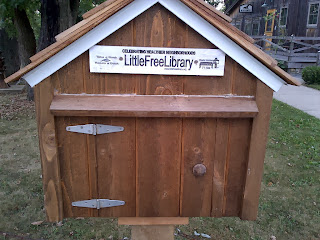
Within less than two blocks I came across two little free libraries.  Wow. Right? But it doesn't stop there. Turns out, that within just a few blocks, there are six. Six Little Free Libraries. To me that says that this community cares about rebuilding not just on the outside, but on the inside. They believe in educating as well as employing, and that sends a powerful message to the people who visit the community as well as those who live there. So hat's off to you, Beloit, WI. All in all, Beloit houses sixteen. 

To find out more about the Little Free Library program, check out the movement that is revolutionizing communities and access to books. LittleFreeLibrary.org

Thursday, May 8, 2014

For the Love of Libraries

Way way back in 1880, Andrew Carnegie had an idea that would shape the future of America, arguably as much as his rail lines did. Beginning with the first investment of $40,000 to fund a public library in Dunfermline. From there, Carnegie and the Carnegie Corporation would go on to invest tens of millions of dollars building public libraries, ultimately being responsible for building 2,509 libraries. *  My great aunt used to house a small public library in her home, which she often joked was the smallest of the Carnegie endowed libraries. Whether it was actually a Carnegie library, or if she just liked to say that, I will never know, as she passed away last autumn. Nonetheless, in her hill-less town of less of than 200, the impact of the movement toward public libraries was keenly felt by the children who could walk down the gravel road to her house after school, browse the few shelves, and pick out a book or two to borrow. Those few shelves of books transformed their world from the flat fields of rice and mosquitoes into boundless territories of information and adventure, where the horizon wasn't the drainage ditch, and their dreams of somewhere distant weren't limited to the shack along the rail line that sold penny candy.

For me, libraries are a fundamental piece of education and community, so this week, I found two stories particularly moving. First, the story highlighted by BBC's Outlook program on May 7th, of Antonio La Cava. La Cava, a retired schoolteacher, possessed with a love of reading and an evangelical mission to spread the love of reading in "Il Bibliomotocarro" by traveling t
he south of Italy, to remote villages in his lovingly hand-built library on wheels, to share books with the children who do not otherwise have easy access to libraries.

Second, the story of how a community came together in a human chain to move the contents of the library in Stanton, Iowa. When the library had completely outgrown it's former home- a tiny old bank- and was moving into a new building some four times the size, over 400 community members, ranging from infants and toddlers, to the retired, with a heavy dose of school children in the mix, came together to span the distance between the buildings, passing thousands of books, hand to hand, from their original home to waiting carts at their new home. Sure, the community group did not get the whole job done, but the did get the bulk of it done, and most importantly, they pulled together for a common cause, and not a single one of those children will forget the day they moved the library, shepherding the books they've read and the books they will read safely from one home to the next, and seeing how important the library, and those books were and are to the hundreds of community members who shared in the experience.

Libraries are a fundamental piece of how we share information and come together as a community, and every time I see a story about libraries bringing people together and creative ways to share the love of reading, my faith in humanity is again restored.

Sunday, October 13, 2013

Life, Literacy, and the Pursuit of Happiness

Literacy changes lives. It opens doors, encourages connections, shrinks the world and expands it. Literacy empowers. As parents, we beam with elation when our children grasp their first toy, when they utter their first nearly word-like string of sounds: their first step, their first real word, their first joke. Then later, when our sons and daughters recognize their first letter, their first word- when they start to recognize that those jumbled strings of sounds can be turned into strings of letters, and that someone can then leave a message for someone else to read later, for anyone else to read later, that elation grows.
In many ways, literacy is the bedrock of our culture. We teach our children through that magnificent written word, and use written words to communicate at nearly every level of daily exchange. It has grown from the height of rarity and privilege to the fulcrum of our lives. The written word defines and instructs. We even build temples to the written word, where librarian priests oversee the ritual of borrowing words and maintaining order, while instructing the next generation in the catechism- I will respect library books, I will read with my eyes, not my jelly sandwich, not my markers, not my scissors, not my shoes.
Because literacy is crucial to success and because literacy empowers, I care about books. I feel passionately about access to books. I care about libraries. I care about books that help people, children and adults, love reading.
Early education programs help promote literacy, as does taking the time to read with a child. The Little Free Library organization creates greater access. A library card can mean the difference between a world that stretches only to the television and a universe filled with limitless permutations of possibility and opportunity. A good book recommendation can make the difference between reading with joy or only as a chore.
Get out there, read with a child. Volunteer with a literacy program- there are adult literacy programs too. Donate a book, help fund or build a LFL in an area where public libraries are scarce. Recommend a good book to someone who is at that point of tension between the difficulty of the words and the value of their content. You are reading this because someone else helped provide the tools for you to learn to read. I am writing this for the same reason. It's our turn.